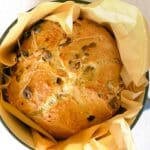
No-Knead Olive Bread (Dutch Oven)
This rustic no-knead olive bread has a crisp, golden crust and a soft, chewy interior dotted with briny olives. A long, slow rise does all the work, developing deep flavor with minimal effort.
Servings: 12 Slices
Calories: 130kcal
Equipment
- 1 dutch oven or baking sheet
- 1 Large bowl
- 1 Sheet of parchment paper
- 2 sheets of plastic wrap
Ingredients
- 3 cups all-purpose flour
- 1½ teaspoons salt
- ¼ teaspoon active dry yeast
- 1½ cups water room temperature
- 1 cup olives drained, pitted, and roughly chopped
- Kalamata, Castelvetrano, or a mix work well
Instructions
Step One: Mix the Dough
- In a large bowl, add the flour, yeast, salt, and water.
- Important: Place the salt and yeast on opposite sides of the bowl at first. Direct contact can deactivate the yeast, but once everything is mixed with the flour, this is no longer an issue.
- Stir until a sticky, shaggy dough forms. Do not knead.
Step Two: Prepare the Olives
- Drain the olives and pat them dry with paper towels. Remove pits if needed, then give the olives a rough chop.
- Pat the chopped olives dry again to remove excess moisture. This helps prevent a gummy loaf.
Step Three: Rest and Rise
- Gently fold the olives into the dough.
- Cover the bowl with plastic wrap or a clean kitchen towel. Let the dough rest at room temperature for 16–18 hours. Note: This long rise is essential for flavor development.
- If your home is cool, the dough may need more time. If it’s warm, it may rise a bit faster. The dough should look bubbly and expanded when ready. The dough should look bubbly and expanded when ready.
Step Four: Shape the Dough
- Lightly dust a sheet of parchment paper with flour.
- Using a spatula or your hands, gently release the dough from the bowl and place it onto the parchment.
- Shape the dough into a loose ball. Do not overwork it.
- Cover with lightly oiled plastic wrap to prevent sticking and let rest for 30 minutes.
- While the dough rests, preheat the oven to 450°F (225°C). Place a Dutch oven with its lid on the middle rack to preheat. The pot must be very hot.
Step Five: Bake
- Carefully transfer the dough, parchment and all, into the hot Dutch oven.
- Using a sharp knife or bread lame, score an “X” on top of the dough.
- Cover with the lid and bake for 30 minutes.
- Remove the lid and bake for an additional 15–20 minutes, until the crust is deep golden brown.
- To check doneness, tap the underside of the loaf. If it sounds hollow, it’s ready.
Cool and Serve
- Transfer the bread to a wire rack and let cool completely before slicing.
Notes
Storing Instructions
You can store this bread at room temperature for up to two days. You will want to wrap it in a tea towel or a paper bag. If you store it in plastic, the bread will become soft, and you will lose the crisp crust. You can slice and freeze the bread if you need to store it longer. First, let it cool to room temperature. Wrap each slice individually in plastic wrap or parchment paper, then place it in a freezer bag. When you’re ready to eat, take a slice and toast it or warm it in the oven at 350°F for about 10 minutes.Nutrition
Calories: 130kcal | Carbohydrates: 24g | Protein: 3g | Fat: 2g | Saturated Fat: 0.3g | Polyunsaturated Fat: 0.3g | Monounsaturated Fat: 1g | Sodium: 468mg | Potassium: 39mg | Fiber: 1g | Sugar: 0.1g | Vitamin A: 44IU | Calcium: 12mg | Iron: 2mg