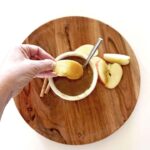
Easy Apple Curd Recipe
Apple curd is a warm and cozy feeling of fall in a jar. This delicious curd is sweet and caramelly, with hints of cinnamon. It is perfect in cakes, on top of crapes, and on toast -- to name a few. This recipe is easy to make and comes together in just ten minutes.
Servings: 40 servings at 2 tablespoons each
Calories: 58kcal
Cost: $5
Equipment
- whisk
- small or medium saucepan
- masher or stick blender
- double boiler or equivalent
- sieve (optional)
Ingredients
- 1 and ½ cup apples peeled, cored, and cut into small pieces (187g) *Use crisp apples
- 3 tablespoons lemon juice
- 2 tablespoons water
- 1 cup brown sugar (213g)
- 1 teaspoon cinnamon (2g)
- 2 large eggs (beaten)
- 8 tablespoons butter (112g)
Instructions
- Apple Prep: Peel, core, and chop apples into small pieces. Place the apples and lemon juice in a small or medium saucepan with water. Cook on low-to-medium heat, covered, until the apples are soft. About 15 to20 minutes. Using a stick blender or a masher, puree the apples until smooth.
- Curd: Using a double boiler, fill the bottom pan with 1 to 2 inches of water. Place over high heat until the water boils, then reduce the heat to low and keep the water simmering. Place the top pot or heat-safe bowl on top of the bottom bowl. In the top pot or bowl, over the simmering water, add the apple puree, brown sugar, and cinnamon, and mix until fully combined. Then add the eggs to the brown sugar and cinnamon mixture. Whisk continuously for two minutes to avoid curdling.
- Butter: Add the butter 1 tablespoon at a time, stirring each tablespoon until fully blended before adding the next tablespoon. Continue whisking for 8 to 10 minutes. For a thicker curd, continue cooking and whisking for up to another 5 minutes.
- Finger Test: Dip a wooden spoon in the curd, then draw your finger across the back, leaving a path. If the path holds, you are done. If the path disappears, continue to cook.
- Setting: Lay a piece of plastic/cling wrap over the top and gently press it onto the surface. This will prevent a skin from forming on the top. Refrigerate until well chilled, at least 4 hours. After the curd is set, transfer it to an airtight container and refrigerate for up to two weeks.
- Optional: For a smooth texture, pass through a fine-mesh sieve.
Notes
• If you do not have a double boiler, use a heat-safe glass bowl on top of a pot of steaming water. I use a glass Pyrex mixing bowl as a double boiler.
• If using a saucepan, ensure the pan is non-reactive to avoid a metallic taste. Stainless steel and tin are non-reactive pans. If unsure, Google your cookware to ensure it is non-reactive.
• Always cook over low, even heat while constantly stirring. You will have scrambled eggs if the heat is too high.
As the curd nears being done, it will thicken.
Nutrition
Calories: 58kcal | Carbohydrates: 9g | Protein: 1g | Fat: 3g | Saturated Fat: 2g | Polyunsaturated Fat: 1g | Monounsaturated Fat: 1g | Trans Fat: 1g | Cholesterol: 15mg | Sodium: 26mg | Potassium: 24mg | Fiber: 1g | Sugar: 9g | Vitamin A: 87IU | Vitamin C: 2mg | Calcium: 10mg | Iron: 1mg